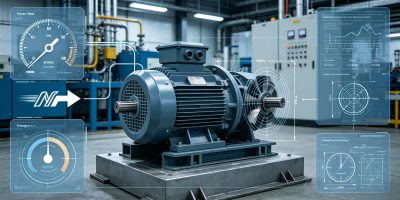
Electric Motor Efficiency is one of the most important factors when selecting industrial electric motors. Higher efficiency motors reduce energy losses, lower operating costs and provide better long-term performance.
Modern industrial facilities increasingly choose high efficiency motors such as IE3 and IE4 models to improve energy savings and meet global efficiency requirements.
Understanding motor efficiency classes helps engineers and purchasing teams select the right motor for their applications.
For reliable industrial applications, Ozan Motor supplies efficient motor solutions including industrial motors, three phase motors and high efficiency motor systems.
What Is Electric Motor Efficiency?
Electric motor efficiency is the ratio between mechanical output power and electrical input power.
A motor cannot convert all electrical energy into mechanical energy because some energy is lost as heat, noise and mechanical friction.
The basic formula is:
Efficiency (%) = Mechanical Output Power ÷ Electrical Input Power × 100
A higher efficiency percentage means the motor wastes less energy during operation.
Why Motor Efficiency Matters
Motor efficiency directly affects operating costs because industrial motors often run for thousands of hours every year.
Higher efficiency motors provide benefits including:
- Lower electricity consumption
- Reduced operating costs
- Lower heat generation
- Improved reliability
- Longer service life
How Electric Motor Efficiency Is Measured
Motor efficiency is measured under rated operating conditions according to international standards.
Efficiency testing evaluates:
- Electrical input power
- Mechanical output power
- Energy losses
- Operating temperature
The efficiency value is normally shown on the motor nameplate.
Learn more about electric motor nameplate information.
Understanding IEC Motor Efficiency Classes
The International Electrotechnical Commission (IEC) defines motor efficiency classes to classify energy performance levels.
The main efficiency categories include:
- IE1 – Standard Efficiency
- IE2 – High Efficiency
- IE3 – Premium Efficiency
- IE4 – Super Premium Efficiency
Higher IE classes indicate improved efficiency and reduced energy losses.
IE1 Standard Efficiency Motors
IE1 motors represent the standard efficiency level in the IEC efficiency classification system.
Compared with newer efficiency classes, IE1 motors have higher energy losses and lower efficiency.
Many markets have introduced regulations that limit the use of lower efficiency motors in new installations.
IE2 High Efficiency Motors
IE2 motors provide improved efficiency compared with IE1 motors.
They reduce energy losses through improved motor design, better materials and optimized electrical performance.
IE2 motors have been widely used in industrial applications before the introduction of higher efficiency requirements.
IE3 Premium Efficiency Motors
IE3 motors are premium efficiency motors designed to provide significant energy savings compared with IE1 and IE2 models.
Advantages of IE3 motors include:
- Lower operating losses
- Reduced electricity costs
- Improved thermal performance
- Better long-term reliability
IE3 motors are now widely used in industrial applications around the world.
IE4 Super Premium Efficiency Motors
IE4 motors represent a higher efficiency level compared with IE3 motors.
They are designed for applications where maximum energy savings and operational efficiency are required.
IE4 motors are commonly selected for:
- Continuous operation systems
- Energy-saving projects
- Large industrial facilities
- Applications with high annual running hours
IE1 vs IE2 vs IE3 vs IE4 Comparison
| Efficiency Class | Description | Energy Performance |
|---|---|---|
| IE1 | Standard Efficiency | Lowest efficiency level |
| IE2 | High Efficiency | Improved energy performance |
| IE3 | Premium Efficiency | Lower losses and higher savings |
| IE4 | Super Premium Efficiency | Maximum efficiency performance |
Energy Savings From High Efficiency Motors
Because industrial motors operate for long periods, even small efficiency improvements can create significant energy savings.
High efficiency motors reduce:
- Electrical losses
- Heat generation
- Cooling requirements
- Total operating costs
Motor Efficiency and Operating Costs
The purchase price of a motor is only a small part of its total lifetime cost.
Energy consumption usually represents the largest operating expense during the motor’s service life.
Choosing a more efficient motor can provide long-term financial benefits.
Factors Affecting Motor Efficiency
Motor Load
Motors operate most efficiently near their rated load conditions.
Operating significantly below or above rated load can reduce efficiency.
Motor Design
Motor materials, winding design and manufacturing quality influence efficiency performance.
Power Quality
Voltage imbalance, harmonics and unstable power supply can reduce motor efficiency.
Maintenance Conditions
Proper lubrication, cooling and alignment help maintain efficient motor operation.
Efficiency Requirements for Industrial Applications
Different industries have different efficiency requirements.
- Pumps require efficient continuous operation
- Fans benefit from reduced energy consumption
- Compressors require reliable high-performance motors
- Production equipment needs stable long-term operation
High Efficiency Motors and Variable Frequency Drives
High efficiency motors are often combined with variable frequency drives (VFDs) to improve system energy performance.
VFD applications allow motors to adjust speed according to load requirements, reducing unnecessary energy consumption.
How to Select an Efficient Industrial Motor
Selecting the correct efficient motor requires evaluating:
- Required power rating
- Operating hours
- Load characteristics
- Efficiency requirements
- Installation environment
Learn more about motor power ratings.
Choosing IE3 or IE4 Motors
IE3 motors are suitable for most modern industrial applications requiring improved efficiency and reliability.
IE4 motors are recommended when maximum energy savings are required or when motors operate continuously for long periods.
Compare the differences between efficiency levels in our IE3 vs IE4 motor guide.
Choosing a Reliable Industrial Motor Supplier
A professional motor supplier should evaluate efficiency requirements, application conditions and operating costs before recommending a motor solution.
Ozan Motor supplies high efficiency industrial motors designed for global applications, including IE3 and IE4 motors, three phase motors and customized motor solutions.
Our team helps customers select efficient motors based on performance requirements and long-term energy saving goals.
Frequently Asked Questions
What is electric motor efficiency?
Electric motor efficiency is the percentage of electrical energy converted into useful mechanical output power.
What are IE efficiency classes?
IE efficiency classes classify industrial motors according to energy performance levels, including IE1, IE2, IE3 and IE4.
Are IE3 motors more efficient than IE2 motors?
Yes. IE3 motors have lower energy losses and higher efficiency compared with IE2 motors.
What are IE4 motors?
IE4 motors are super premium efficiency motors designed for higher energy savings.
Why choose high efficiency motors?
High efficiency motors reduce energy consumption, lower operating costs and improve long-term reliability.