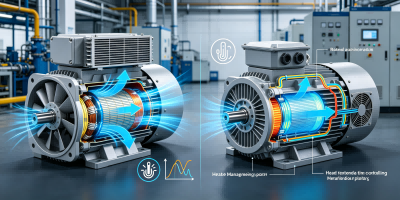
Electric Motor Cooling Methods are essential for maintaining safe operating temperatures, improving reliability and extending the service life of industrial electric motors.
During operation, electric motors generate heat caused by electrical losses, mechanical friction and operating loads. Without effective cooling, excessive temperature can damage insulation systems, reduce efficiency and shorten motor lifespan.
When selecting industrial motors, understanding cooling systems such as IC411 and IC416 helps engineers choose the right motor solution for specific operating conditions.
Why Electric Motor Cooling Is Important
Cooling is a critical part of industrial motor design because all electric motors produce heat during operation.
Effective cooling helps:
- Maintain safe operating temperature
- Protect motor insulation
- Improve energy efficiency
- Prevent overheating failures
- Extend motor service life
Proper thermal management is especially important for motors operating continuously or under heavy loads.
How Electric Motors Generate Heat
Electric motors generate heat through several sources:
- Copper losses in motor windings
- Iron losses in the magnetic core
- Bearing friction
- Mechanical losses
- High operating loads
The cooling system removes this heat and maintains the motor within its designed temperature range.
Common Electric Motor Cooling Methods
Industrial motors use different cooling methods depending on motor design, power rating and application requirements.
Common cooling systems include:
- Self-cooled motors
- Totally enclosed fan cooled motors
- Forced ventilation motors
- Water cooled motors
IC Motor Cooling Classification Explained
IEC standards define motor cooling methods using the IC (International Cooling) classification system.
The IC code identifies:
- Cooling method
- Cooling medium
- Ventilation arrangement
Understanding IC classifications helps customers select motors suitable for different environments and operating requirements.
IC411 Cooling System Explained
IC411 motor cooling is one of the most common cooling methods used in industrial electric motors.
IC411 motors are typically designed as Totally Enclosed Fan Cooled (TEFC) motors.
The cooling system includes:
- An external cooling fan mounted on the motor shaft
- Cooling fins on the motor housing
- Airflow over the external surface
During operation, the shaft-driven fan rotates with the motor and provides airflow to remove heat from the motor frame.
Advantages of IC411 Motors
- Reliable cooling performance
- Simple and durable design
- Low maintenance requirements
- Suitable for general industrial applications
- Good protection against dust and moisture
IC416 Cooling System Explained
IC416 motor cooling uses an independent external fan to provide forced ventilation.
Unlike IC411 motors, the cooling fan operates separately from the motor shaft.
This allows consistent airflow even when:
- The motor speed changes
- The motor operates with a variable frequency drive
- The motor runs under demanding conditions
Advantages of IC416 Cooling
- Improved cooling at low speeds
- Better thermal control
- Suitable for variable speed applications
- Improved overload capability
TEFC Motor Cooling Explained
TEFC motor cooling is one of the most widely used cooling designs for industrial motors.
TEFC means Totally Enclosed Fan Cooled.
The motor enclosure prevents external contaminants from entering while an external fan provides cooling airflow.
TEFC motors are commonly used in:
- Pumps
- Fans
- Compressors
- Conveyors
- Manufacturing equipment
ODP Motor Cooling Explained
ODP (Open Drip Proof) motors use an open ventilation design that allows air movement through the motor housing.
Advantages:
- Good cooling efficiency
- Lower initial cost
- Suitable for clean indoor environments
However, ODP motors are not suitable for dusty, wet or harsh industrial environments.
Air Cooling vs Other Cooling Methods
Most industrial motors use air cooling because it provides a reliable and cost-effective solution.
However, large motors may require alternative cooling methods such as water cooling.
External Fan Cooling
External fan cooling uses airflow generated by a fan mounted on or connected to the motor.
It is widely used because of its simple structure and easy maintenance.
Self Cooling Motors
Self-cooled motors use the rotation of the motor shaft to drive airflow.
They are suitable for applications with stable speed and normal operating conditions.
Forced Ventilation Cooling
Forced ventilation systems use an independent fan to provide controlled airflow.
They are commonly used in:
- Variable speed motor applications
- Heavy-duty industrial equipment
- Continuous operation systems
Water Cooled Motors
Water cooled motors use liquid cooling systems to remove heat.
They are typically used in high-power applications requiring advanced thermal control.
Motor Cooling and Efficiency
Effective cooling improves motor efficiency by maintaining optimal operating temperatures.
Excessive heat increases electrical losses and reduces motor performance.
For energy-saving applications, customers often select high efficiency motors with advanced thermal designs.
Motor Cooling and Service Life
Temperature control directly affects motor reliability.
Proper cooling helps protect:
- Motor windings
- Insulation systems
- Bearings
- Internal components
Learn more about motor insulation classes.
Factors Affecting Motor Temperature
Load Conditions
Operating a motor above its rated load increases heat generation and thermal stress.
Ambient Temperature
High ambient temperatures reduce the motor’s ability to dissipate heat.
Installation Environment
Dust, moisture and hazardous environments require suitable motor protection designs.
For demanding environments, solutions such as explosion proof motors may be required.
Cooling Systems for Industrial Motors
Industrial motor cooling systems are selected according to:
- Motor power
- Operating speed
- Duty cycle
- Installation conditions
- Environmental requirements
Cooling Methods in Low Voltage Motors
Most low voltage industrial motors use IC411 TEFC cooling because it provides reliable protection and efficient heat dissipation.
Learn more about low voltage motors.
Cooling Methods in High Voltage Motors
High voltage motors often require advanced cooling systems because of their large size and higher power output.
Cooling design is critical for applications such as mining, power generation and heavy industrial equipment.
How to Select the Right Motor Cooling Method
The correct cooling method depends on the application environment and operating requirements.
- Normal industrial environment: IC411 TEFC cooling
- Variable speed operation: IC416 forced ventilation
- High power applications: advanced cooling systems
- Harsh environments: protected enclosure designs
Choosing a Reliable Industrial Motor Supplier
A professional motor supplier should evaluate cooling requirements together with power rating, efficiency, insulation class and protection level.
Ozan Motor supplies industrial electric motors designed for global applications, including three phase motors, high efficiency motors and customized motor solutions.
Our team helps customers select motors with suitable cooling systems based on operating conditions and application requirements.
Frequently Asked Questions
Why do electric motors need cooling?
Electric motors need cooling to remove heat generated during operation and prevent overheating damage.
What is IC411 motor cooling?
IC411 is a common IEC cooling method using a shaft-mounted external fan to cool the motor housing.
What is IC416 motor cooling?
IC416 uses an independent fan to provide forced ventilation and improved cooling control.
What is TEFC motor cooling?
TEFC means Totally Enclosed Fan Cooled, a motor design using an enclosed housing and external cooling fan.
How does cooling affect motor life?
Proper cooling reduces thermal stress, protects insulation and extends industrial motor service life.