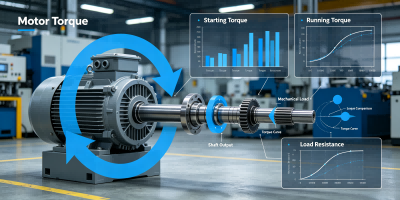
Electric Motor Torque is a key factor in industrial motor selection because it determines the ability of a motor to start, accelerate and drive mechanical loads.
While motor power defines the amount of work a motor can deliver, torque determines the rotational force available at the motor shaft.
Understanding starting torque, running torque and load requirements helps engineers select suitable motors for pumps, fans, compressors, conveyors and other industrial equipment.
Ozan Motor supplies industrial electric motors designed for different torque requirements and operating conditions worldwide.
What Is Electric Motor Torque?
Electric motor torque is the rotational force produced by the motor shaft. It is usually measured in Newton meters (Nm) or pound-feet (lb-ft).
Torque allows a motor to overcome resistance and rotate connected equipment.
The amount of torque required depends on factors such as:
- Load type
- Starting conditions
- Operating speed
- Application requirements
Understanding Motor Torque Rating
A motor torque rating indicates the amount of rotational force a motor can provide under specific operating conditions.
Motor torque is closely related to power and speed.
The basic relationship is:
Power = Torque × Speed
A motor with higher torque capability can handle heavier mechanical loads and more demanding applications.
How Motor Torque Is Calculated
Motor torque can be calculated using the relationship between power and rotational speed.
For industrial motors, torque is commonly calculated using:
Torque (Nm) = 9550 × Power (kW) ÷ Speed (RPM)
For example, a motor with higher power output or lower operating speed generally produces higher torque.
Starting Torque Explained
Starting torque is the torque produced by an electric motor when it begins rotating from a stopped position.
Starting torque is especially important for applications that require high force during startup.
Examples include:
- Heavy conveyors
- Compressors
- Large pumps
- Industrial machinery
A motor with insufficient starting torque may not be able to accelerate the connected equipment properly.
Running Torque Explained
Running torque is the torque required by a motor during normal operating conditions after reaching its working speed.
The motor must continuously provide enough running torque to maintain stable operation.
Applications with continuous loads usually require consistent running torque performance.
Locked Rotor Torque Explained
Locked rotor torque refers to the torque produced when the motor starts from zero speed with full voltage applied.
This characteristic is important when selecting motors for applications requiring strong starting capability.
Breakdown Torque Explained
Breakdown torque is the maximum torque an induction motor can produce before losing stable operation.
A motor with higher breakdown torque can better handle temporary increases in mechanical load.
Pull-Up Torque Explained
Pull-up torque is the minimum torque available during acceleration from startup to normal operating speed.
It affects how smoothly a motor accelerates connected equipment.
Relationship Between Torque and Motor Power
Torque and power are closely connected but represent different motor characteristics.
- Power describes the rate of doing work
- Torque describes rotational force
A motor may have the same power rating but different torque characteristics depending on speed.
Learn more about electric motor power ratings.
Relationship Between Torque and Motor Speed
Motor speed and torque affect each other during operation.
Generally:
- Lower speed motors provide higher torque
- Higher speed motors provide lower torque at the same power rating
The correct balance depends on the application requirements.
Learn more about electric motor speed.
High Torque Electric Motors Explained
High torque electric motors are designed for applications requiring strong starting capability and reliable operation under heavy loads.
Typical applications include:
- Mining equipment
- Heavy conveyors
- Large compressors
- Industrial processing machines
Why Starting Torque Is Important
Starting torque directly affects whether a motor can successfully start the connected machine.
Applications with high starting resistance require motors with suitable starting torque characteristics.
Important factors include:
- Initial load condition
- Acceleration requirements
- Starting frequency
- Mechanical system design
Motor Torque Selection for Industrial Applications
Pump Motor Torque Requirements
Pump applications require suitable torque to overcome fluid resistance and accelerate rotating components during startup.
Fan Motor Torque Requirements
Fans usually require lower starting torque but must maintain stable operation during continuous running.
Compressor Motor Torque Requirements
Compressors often require higher starting torque because of pressure loads during startup.
Conveyor Motor Torque Requirements
Conveyors require reliable torque because motors must move materials and overcome starting resistance.
Common Factors Affecting Motor Torque
Motor torque selection should consider:
- Motor power rating
- Operating speed
- Load characteristics
- Starting requirements
- Duty cycle
- Mechanical transmission system
How to Select the Correct Motor Torque
Selecting the correct torque rating requires understanding the complete application requirements.
Engineers should evaluate:
- Required starting torque
- Continuous running torque
- Load variations
- Operating environment
- Future capacity requirements
Choosing the correct torque helps ensure reliable motor performance and efficient operation.
Choosing a Reliable Industrial Motor Supplier
A professional motor supplier should evaluate application requirements, load conditions and operating characteristics before recommending a motor.
Ozan Motor provides industrial electric motors suitable for various applications, including three phase motors, low voltage motors, high voltage motors and customized motor solutions.
Our team helps customers select motors based on power, speed, torque and application requirements.
Frequently Asked Questions
What is electric motor torque?
Electric motor torque is the rotational force produced by a motor shaft to drive mechanical equipment.
What is starting torque in an electric motor?
Starting torque is the torque available when a motor begins rotating from a stopped position.
What is running torque?
Running torque is the torque required to maintain normal motor operation after reaching operating speed.
Why is motor torque important?
Motor torque determines whether a motor can start and operate the connected equipment effectively.
How do I select the correct motor torque?
Motor torque selection depends on load requirements, starting conditions, speed and application characteristics.