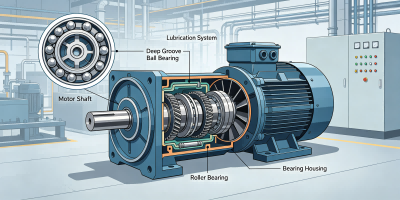
Electric Motor Bearings are essential mechanical components that support the motor shaft, reduce friction and ensure smooth rotation during operation. Proper bearing selection and maintenance directly affect industrial motor reliability, efficiency and service life.
Industrial motors often operate continuously under demanding conditions. High loads, high speeds and harsh environments make bearing performance a critical factor in maintaining stable motor operation.
When selecting industrial motors, understanding bearing types and maintenance requirements helps engineers choose reliable motor solutions for long-term performance.
What Are Electric Motor Bearings?
Electric motor bearings are mechanical elements installed between the rotating shaft and stationary motor components.
Their main function is to:
- Support the motor shaft
- Reduce friction during rotation
- Maintain shaft alignment
- Handle radial and axial loads
- Improve motor operating efficiency
Without properly designed bearings, motors would experience excessive friction, vibration and premature failure.
Why Bearings Are Important in Electric Motors
Bearings are among the most important components affecting motor reliability.
A motor bearing failure can lead to:
- Increased vibration
- Higher operating temperature
- Noise generation
- Shaft damage
- Unexpected equipment downtime
For industrial applications, selecting suitable bearings and maintaining them correctly helps extend motor service life.
Common Types of Electric Motor Bearings
Different motor designs and operating conditions require different bearing solutions.
The most common motor bearing types include:
- Deep groove ball bearings
- Angular contact ball bearings
- Cylindrical roller bearings
- Spherical roller bearings
Deep Groove Ball Bearings
Deep groove ball bearings are the most commonly used bearings in electric motors.
They are suitable for applications requiring:
- High-speed operation
- Low friction
- Compact design
- Reliable continuous performance
Many small and medium industrial motors use deep groove ball bearings because of their durability and cost-effectiveness.
Angular Contact Ball Bearings
Angular contact ball bearings are designed to handle combined radial and axial loads.
They are often used in applications where shaft positioning accuracy and axial load capacity are important.
Roller Bearings
Roller bearings use cylindrical or spherical rolling elements to support heavier loads compared with standard ball bearings.
They are commonly used in larger industrial motors where high mechanical loads are present.
Cylindrical Roller Bearings
Cylindrical roller bearings provide excellent radial load capacity.
They are often selected for:
- Large industrial motors
- Heavy-duty equipment
- High-load applications
Spherical Roller Bearings
Spherical roller bearings are designed to handle heavy loads and accommodate slight shaft misalignment.
They are commonly used in demanding industrial applications where reliability is critical.
Bearing Selection Factors for Motors
Choosing the correct bearing requires evaluating several operating conditions.
Motor Speed
High-speed motors require bearings designed for reduced friction and stable operation at higher rotational speeds.
Load Requirements
Motor bearings must handle the mechanical loads generated by the driven equipment.
Load considerations include:
- Radial load
- Axial load
- Combined loads
Operating Environment
Dust, moisture and contaminants can significantly affect bearing performance.
Motors used in harsh environments may require enhanced protection designs such as appropriate motor enclosure types.
Temperature Conditions
High operating temperatures can reduce lubricant performance and shorten bearing life.
Proper cooling and insulation systems help maintain reliable motor operation.
Lubrication Requirements
Correct lubrication reduces friction and prevents excessive wear.
The lubricant type and maintenance schedule depend on motor size, speed and operating conditions.
Bearing Maintenance for Industrial Motors
Regular bearing maintenance is essential for preventing unexpected motor failures.
Lubrication Management
Proper lubrication helps reduce friction and control operating temperature.
Both insufficient lubrication and excessive lubrication can negatively affect bearing performance.
Temperature Monitoring
Monitoring bearing temperature helps identify potential problems before serious damage occurs.
Abnormal temperature increases may indicate lubrication issues, overload or bearing wear.
Vibration Analysis
Vibration monitoring is widely used in industrial facilities to detect bearing problems.
Changes in vibration patterns may indicate:
- Bearing damage
- Misalignment
- Mechanical imbalance
Regular Inspection
Routine inspections help identify early signs of wear and allow preventive maintenance.
Common Motor Bearing Problems
Bearing Wear
Continuous operation, contamination and insufficient lubrication can cause gradual bearing wear.
Overheating
Excessive temperature can damage bearings and reduce lubricant effectiveness.
Lubrication Failure
Incorrect lubrication practices are one of the most common causes of bearing failure.
Misalignment
Shaft or coupling misalignment can create additional bearing stress and vibration.
Contamination
Dust, water and foreign particles can damage bearing surfaces and reduce service life.
How Bearings Affect Motor Reliability
Reliable bearings help maintain:
- Smooth shaft rotation
- Lower vibration levels
- Reduced mechanical losses
- Stable motor performance
- Longer operating life
Bearing quality is especially important for motors used in continuous industrial applications.
Bearings in High Voltage Motors
High voltage motors typically operate under demanding conditions and require robust bearing systems.
Large motors used in industries such as mining, power generation and oil & gas often require advanced bearing designs to handle high loads and long operating periods.
Learn more about high voltage motors.
Bearings in Three Phase Motors
Three phase motors commonly use reliable bearing systems because they are designed for continuous industrial operation.
Proper bearing selection improves efficiency and reduces maintenance requirements.
Learn more about three phase motors.
Choosing a Reliable Industrial Motor Supplier
A professional motor supplier should consider bearing design, insulation system, enclosure protection and operating conditions when recommending motor solutions.
Ozan Motor supplies reliable industrial electric motors for global applications, including three phase motors, high efficiency motors and customized motor solutions.
We provide motor solutions from leading brands including ABB motors, WEG motors and Siemens motors.
Our team helps customers select suitable motors based on application requirements, performance expectations and operating environments.
Frequently Asked Questions
What are electric motor bearings?
Electric motor bearings support the rotating shaft, reduce friction and help maintain smooth motor operation.
What types of bearings are used in electric motors?
Common motor bearing types include deep groove ball bearings, angular contact bearings and roller bearings.
Why do motor bearings fail?
Common causes include poor lubrication, overheating, contamination, excessive loads and misalignment.
How can motor bearing life be extended?
Proper lubrication, vibration monitoring, temperature control and regular inspection help extend bearing service life.
Are bearings important for industrial motor reliability?
Yes. Bearings directly affect motor efficiency, vibration levels and long-term operating reliability.