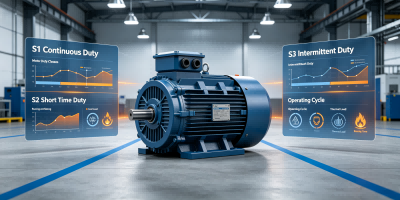
Electric Motor Duty Classes define how an electric motor operates under different load conditions, running times and starting cycles.
Selecting the correct motor duty class is essential because industrial motors are often required to operate continuously, intermittently or under changing loads.
The IEC motor duty classification system helps engineers choose motors that can handle specific operating conditions without overheating or reducing service life.
Ozan Motor supplies reliable industrial electric motors designed for different duty requirements, including continuous operation, heavy-duty applications and customized motor solutions.
What Are Electric Motor Duty Classes?
Electric motor duty classes describe the operating pattern of a motor, including running time, load changes, starting frequency and rest periods.
A motor’s duty class determines how it handles heat generated during operation.
Important operating factors include:
- Operating time
- Load variation
- Starting frequency
- Stopping periods
- Motor cooling conditions
Why Motor Duty Classification Is Important
Choosing the correct duty class ensures that a motor can safely handle the actual working conditions of the application.
Incorrect duty selection may cause:
- Motor overheating
- Reduced efficiency
- Insulation damage
- Shorter service life
- Unexpected downtime
Proper duty classification improves reliability and helps optimize motor performance.
Understanding Motor Duty Cycle
A motor duty cycle describes the relationship between operating periods and rest periods during normal operation.
Different machines require different duty cycles.
For example:
- Pumps may require continuous operation
- Cranes may require frequent starting and stopping
- Compressors may operate under changing loads
IEC Motor Duty Classification System
The IEC 60034-1 standard defines international motor duty classifications.
The main duty types include:
- S1 – Continuous Duty
- S2 – Short Time Duty
- S3 – Intermittent Periodic Duty
- S4-S10 – Special operating conditions
Among industrial applications, S1, S2 and S3 are the most commonly referenced motor duty classes.
S1 Continuous Duty Explained
S1 continuous duty is the most common motor operating mode.
An S1 motor operates continuously at a constant load until it reaches thermal equilibrium.
Typical applications include:
- Pumps
- Fans
- Blowers
- Production machinery
- Continuous processing equipment
Most standard industrial motors are designed for S1 continuous operation.
S2 Short Time Duty Explained
S2 short time duty refers to motors operating for a limited period followed by a sufficient cooling period.
The motor does not reach thermal equilibrium during operation.
Examples include:
- Actuators
- Positioning systems
- Short operating machines
An S2 motor rating normally includes the operating time, such as S2 30 minutes or S2 60 minutes.
S3 Intermittent Periodic Duty Explained
S3 intermittent duty consists of repeated operating cycles including running periods and rest periods.
During S3 operation:
- The motor starts
- The motor operates under load
- The motor stops
- The motor cools during rest time
Starting heat losses are considered separately because the motor has cooling periods between cycles.
Common S3 applications include:
- Cranes
- Hoists
- Material handling equipment
- Machines with frequent cycles
Other IEC Motor Duty Classes
S4 Intermittent Periodic Duty with Starting
S4 duty includes repeated starting cycles where starting losses significantly affect motor heating.
It is commonly used in applications with frequent starts and stops.
S5 Intermittent Duty with Electric Braking
S5 duty includes starting, operation, electric braking and rest periods.
It is used where controlled stopping is required.
S6 Continuous Operation with Periodic Load
S6 duty involves continuous operation with alternating load and no rest periods.
The motor operates continuously but the load changes periodically.
S7 Continuous Operation with Electric Braking
S7 duty includes continuous operation with starting and electric braking cycles.
S8 Continuous Operation with Periodic Speed Changes
S8 duty applies to motors operating with repeated cycles of different speeds and loads.
S9 Duty with Non Periodic Load and Speed Variations
S9 duty is designed for applications with continuously changing speed and load conditions.
S1 vs S2 vs S3 Motor Duty Comparison
| Duty Class | Operating Mode | Typical Applications |
|---|---|---|
| S1 | Continuous operation | Pumps, fans, compressors |
| S2 | Limited operating time | Actuators, short cycles |
| S3 | Periodic start and stop cycles | Cranes, hoists, machinery |
How Duty Class Affects Motor Selection
Motor selection should consider the actual operating cycle rather than only power rating.
Important factors include:
- Running hours per day
- Load profile
- Number of starts per hour
- Cooling conditions
- Required service life
A motor designed for continuous duty may not be suitable for applications with frequent starts and stops.
Motor Duty Classes for Industrial Applications
Pumps
Most pump applications require S1 continuous duty because pumps often operate for long periods.
Fans
Industrial fans typically use S1 duty motors due to continuous airflow requirements.
Compressors
Compressors may require continuous duty or specialized duty depending on operating cycles.
Conveyors
Conveyor systems often require continuous operation and reliable torque performance.
Mining Equipment
Mining applications may require motors designed for demanding duty cycles and harsh environments.
How to Select the Correct Motor Duty Class
The correct duty class depends on:
- Machine operating cycle
- Load characteristics
- Starting frequency
- Environmental conditions
- Motor cooling method
Engineers should evaluate the complete operating profile before selecting a motor.
Duty Cycle and Motor Service Life
Proper duty selection helps maintain acceptable operating temperatures and prevents excessive thermal stress.
Correctly selected motors provide:
- Longer insulation life
- Better reliability
- Lower maintenance costs
- Stable performance
Learn more about motor insulation classes.
Choosing a Reliable Industrial Motor Supplier
A professional motor supplier should evaluate duty requirements, load conditions and application environment before recommending a motor.
Ozan Motor provides industrial electric motors suitable for various operating modes, including continuous duty motors and customized industrial solutions.
Our team helps customers select motors with the correct duty class for reliable long-term operation.
Frequently Asked Questions
What are electric motor duty classes?
Electric motor duty classes define how motors operate according to running time, load conditions and operating cycles.
What is an S1 continuous duty motor?
An S1 motor is designed for continuous operation at constant load until reaching thermal equilibrium.
What is an S2 short time duty motor?
An S2 motor operates for a limited period and then requires a cooling period.
What is an S3 intermittent duty motor?
An S3 motor operates in repeated cycles of running and stopping with rest periods.
Why are motor duty classes important?
Motor duty classes help engineers select motors that can handle specific operating conditions without overheating or premature failure.