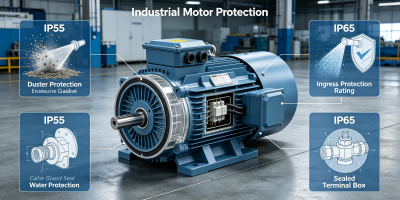
Electric Motor Protection Classes define how well an electric motor is protected against dust, water, mechanical impact and environmental conditions.
Selecting the correct protection level is essential for industrial applications because motors often operate in challenging environments including factories, outdoor installations, chemical plants and heavy industries.
The protection level of an electric motor affects reliability, maintenance requirements and service life.
For global industrial applications, Ozan Motor supplies reliable motor solutions including industrial motors, low voltage motors and customized motor systems designed for different environments.
What Are Electric Motor Protection Classes?
Electric motor protection classes describe the level of protection provided by the motor enclosure against external conditions.
Protection design helps prevent damage caused by:
- Dust and solid particles
- Water exposure
- Moisture
- Industrial contaminants
- Mechanical impact
The most common international protection classification system for motors is the IP rating system defined by IEC standards.
Understanding IP Ratings for Electric Motors
The IP rating, also known as Ingress Protection rating, indicates how effectively an enclosure protects internal motor components from external elements.
An IP code normally contains two numbers:
- The first number indicates protection against solid objects
- The second number indicates protection against water
For example, an IP55 motor provides protection against dust and water jets from any direction.
How IP Codes Are Defined
The IP classification system uses different levels to describe motor protection performance.
Higher numbers indicate stronger protection.
First Digit: Protection Against Solid Objects
The first IP digit describes protection against solid particles and contact with internal components.
| First Digit | Protection Level |
|---|---|
| 0 | No protection |
| 1-4 | Protection against larger solid objects |
| 5 | Dust protected |
| 6 | Dust tight |
Second Digit: Protection Against Water
The second IP digit describes resistance against water.
| Second Digit | Protection Level |
|---|---|
| 0 | No protection |
| 3 | Protection against spraying water |
| 4 | Protection against splashing water |
| 5 | Protection against water jets |
| 6 | Protection against powerful water jets |
Common Motor IP Ratings
IP23 Motors
IP23 motors provide basic protection against solid objects and water spray.
They are commonly used in controlled indoor environments where additional protection is not required.
IP44 Motors
IP44 motors provide improved protection against solid particles and water splashes.
They are suitable for general industrial applications.
IP54 Motors
IP54 motors provide dust protection and protection against water splashes.
They are often used in environments requiring moderate protection.
IP55 Motors
IP55 motors are among the most common industrial motor protection designs.
They provide:
- Dust protection
- Protection against water jets
- Reliable operation in industrial environments
IP55 motors are widely used for pumps, fans, compressors and manufacturing equipment.
IP65 Motors
IP65 motors provide higher protection with a dust-tight enclosure and stronger water protection.
They are suitable for applications where motors may be exposed to dust, moisture or outdoor conditions.
IP66 Motors
IP66 motors provide even higher environmental protection.
They are designed for demanding applications requiring strong protection against dust and powerful water jets.
Motor Enclosure Types Explained
Motor enclosure design determines how effectively the motor is protected during operation.
Open Drip Proof (ODP) Motors
ODP motors have openings that allow cooling airflow while providing protection against vertical dripping water.
They are generally used in clean and dry indoor environments.
Totally Enclosed Fan Cooled (TEFC) Motors
TEFC motors are widely used in industrial applications because they provide a completely enclosed design with external cooling fans.
Advantages include:
- Better environmental protection
- Reduced contamination risk
- Suitable for industrial environments
- Reliable continuous operation
Totally Enclosed Non Ventilated (TENV) Motors
TENV motors are completely enclosed and cooled without an external fan.
They are suitable for applications requiring compact motor designs and lower power levels.
Explosion Proof Motor Protection
Some industrial environments contain flammable gases, vapors or combustible dust.
In these applications, explosion proof motors provide specialized protection to prevent ignition risks.
Learn more about explosion proof motors.
Environmental Factors Affecting Motor Protection
Dust Protection
Dust accumulation can reduce cooling performance and damage internal components.
Higher IP ratings help protect motors operating in dusty environments.
Water Exposure
Outdoor installations and wash-down environments require motors with suitable water protection.
Chemical Environment
Chemical industries may require special materials and protection designs to prevent corrosion.
Outdoor Installation
Outdoor motors typically require stronger enclosure protection against rain, humidity and temperature changes.
Industrial Motor Protection Selection Guide
Choosing the correct protection class depends on:
- Installation environment
- Dust and moisture levels
- Operating temperature
- Cleaning requirements
- Industry regulations
IP55 vs IP65 Motor Comparison
| Feature | IP55 Motor | IP65 Motor |
|---|---|---|
| Dust Protection | Protected | Dust tight |
| Water Protection | Water jets | Water jets with higher sealing |
| Typical Application | General industrial use | Harsh environments |
How to Choose the Right Motor Protection Level
The correct motor protection level depends on the actual operating environment.
- Clean indoor environment: IP44 or IP54
- General industrial environment: IP55
- Dusty or outdoor applications: IP65 or higher
- Hazardous areas: Explosion proof motor designs
Protection Requirements for Different Applications
- Pumps may require moisture-resistant protection
- Mining equipment requires strong dust protection
- Food processing equipment may require wash-down protection
- Marine applications require corrosion-resistant designs
Choosing a Reliable Industrial Motor Supplier
A professional motor supplier should consider application environment, protection requirements and operating conditions before recommending a motor.
Ozan Motor supplies industrial electric motors designed for different environments, including high efficiency motors, three phase motors and customized solutions.
Our team helps customers select suitable motors with the correct protection class for reliable long-term operation.
Frequently Asked Questions
What are electric motor protection classes?
Electric motor protection classes define how well a motor is protected against dust, water and environmental conditions.
What does IP55 mean on a motor?
IP55 means the motor is protected against dust and water jets from different directions.
What is the difference between IP55 and IP65 motors?
IP65 provides higher dust protection because it is completely dust tight.
What is a TEFC motor enclosure?
TEFC means Totally Enclosed Fan Cooled, a common industrial motor enclosure design.
How do I choose the correct motor protection level?
The correct protection level depends on installation environment, moisture, dust and application requirements.