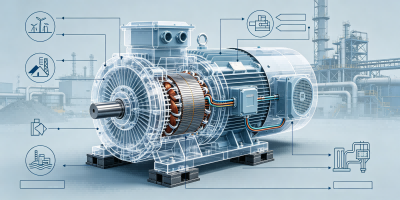
High Voltage Motors are powerful industrial electric motors designed for applications requiring high power output, reliable operation and efficient energy conversion. They are widely used in heavy industries where large machines need continuous and stable performance.
Industries such as mining, oil and gas, power generation, water treatment and large manufacturing facilities depend on high voltage motors to drive critical equipment including pumps, compressors, fans and conveyors.
When selecting industrial motors, understanding high voltage motor applications, advantages and selection factors helps engineers choose the right solution for demanding industrial environments.
What Are High Voltage Motors?
High voltage motors are electric motors designed to operate at higher voltage levels compared with standard low voltage motors.
By using higher operating voltage, these motors can deliver large amounts of mechanical power while reducing electrical current requirements.
High voltage motors are typically used for large industrial equipment where motor power ratings range from hundreds of kilowatts to several megawatts.
How High Voltage Motors Work
Like other induction and synchronous motors, high voltage motors convert electrical energy into mechanical energy through electromagnetic interaction between the stator and rotor.
The main components include:
- Stator winding system
- Rotor assembly
- Motor frame
- Bearing system
- Cooling system
- Insulation system
Because high voltage motors operate under greater electrical stress, they require advanced insulation systems and reliable protection designs.
High Voltage Motors vs Low Voltage Motors
| Category | High Voltage Motors | Low Voltage Motors |
|---|---|---|
| Operating Voltage | Higher voltage levels | Lower voltage levels |
| Power Range | Large industrial applications | Small and medium applications |
| Current Requirement | Lower operating current for same power | Higher current requirement |
| Applications | Heavy industrial equipment | General industrial machinery |
| Installation | Requires specialized systems | Simpler installation |
Advantages of High Voltage Motors
High voltage motors provide several benefits for large industrial applications.
Higher Power Capability
The biggest advantage of high voltage motors is their ability to deliver large amounts of power for heavy-duty equipment.
They are ideal for applications where standard motors cannot provide sufficient output.
Improved Efficiency
High voltage motors can achieve excellent efficiency levels because they operate with reduced electrical losses at high power ratings.
Lower losses help reduce operating costs during continuous industrial operation.
Reduced Current and Cable Requirements
For the same power output, higher voltage operation requires less electrical current.
This can reduce cable size requirements and improve system efficiency in large installations.
High Voltage Motor Applications
High voltage motors are widely used in industries requiring reliable continuous operation.
Power Plants
Power generation facilities use high voltage motors for equipment such as pumps, fans and auxiliary systems.
Mining Industry
Mining operations require powerful motors for conveyors, crushers, ventilation systems and processing equipment.
High voltage motors provide reliable performance in demanding mining environments.
Learn more about mining applications.
Oil and Gas Industry
Oil and gas facilities use high voltage motors for compressors, pumps and large processing equipment.
These applications require motors with high reliability and long operating life.
Learn more about oil and gas applications.
Water Treatment
Large water treatment facilities use high voltage motors to drive pumps and other critical equipment requiring continuous operation.
Industrial Manufacturing
Heavy manufacturing plants use high voltage motors for production lines, compressors and large mechanical systems.
Types of High Voltage Motors
High Voltage Induction Motors
High voltage induction motors are the most common type used in industrial applications.
They provide reliable operation, simple maintenance and excellent performance for continuous-duty applications.
Synchronous High Voltage Motors
Synchronous high voltage motors operate at constant speed and are often selected for applications requiring precise speed control and high efficiency.
They are commonly used in large industrial processes where stable operation is essential.
High Voltage Motor Selection Factors
Selecting the correct high voltage motor requires careful evaluation of technical requirements.
Power Rating
The motor power rating must match the mechanical load requirements of the driven equipment.
Incorrect sizing may lead to reduced efficiency, overheating or unnecessary operating costs.
Voltage Level
The selected voltage should match the facility electrical system and available power supply.
Speed Requirements
Motor speed must match the operating requirements of the connected equipment.
Applications such as pumps and compressors often require specific speed characteristics.
Starting Method
Large high voltage motors may require specialized starting methods to reduce electrical impact on the power system.
Common methods include:
- Direct online starting
- Soft starting
- Variable frequency drive systems
Cooling System
Proper cooling is essential because high voltage motors generate significant heat during operation.
Cooling methods may include:
- Air cooling
- Water cooling
- Closed cooling systems
Protection Requirements
Depending on the environment, high voltage motors may require additional protection features.
Examples include:
- Explosion proof protection
- High temperature protection
- Advanced insulation systems
Learn more about explosion proof motors for hazardous environments.
High Voltage Motor Efficiency and Reliability
Industrial customers choose high voltage motors because reliability and efficiency directly affect production performance.
Important factors affecting motor reliability include:
- Insulation quality
- Bearing design
- Cooling performance
- Operating conditions
- Maintenance practices
Understanding motor insulation classes helps engineers select suitable motors for demanding applications.
Maintenance Considerations for HV Motors
Regular maintenance helps extend the service life of high voltage motors.
Recommended practices include:
- Insulation testing
- Bearing inspection
- Vibration monitoring
- Temperature monitoring
- Electrical testing
Choosing the Right High Voltage Motor Supplier
Selecting a reliable supplier is important for high voltage motor projects because these motors are critical components in industrial operations.
A professional supplier should provide technical support, suitable motor specifications and solutions based on actual application requirements.
Ozan Industrial Motors supplies high performance industrial electric motors for heavy-duty applications including pumps, compressors, fans and industrial machinery.
Our team helps customers select suitable high voltage motor solutions based on power requirements, operating conditions and industry standards.
Frequently Asked Questions
What are high voltage motors used for?
High voltage motors are used for large industrial equipment including pumps, compressors, fans, conveyors and processing machinery.
What is the difference between high voltage and low voltage motors?
High voltage motors operate at higher voltage levels and are designed for large power applications, while low voltage motors are commonly used for smaller industrial equipment.
Why are high voltage motors more efficient?
High voltage motors reduce electrical current requirements for the same power output, which can reduce energy losses and improve efficiency.
Which industries use high voltage motors?
Common industries include mining, oil and gas, power generation, water treatment and heavy manufacturing.
How do I select the right high voltage motor?
Selection depends on power rating, voltage level, speed, cooling method, protection requirements and operating environment.