Electric Motor Speed is one of the most important factors when selecting an industrial motor. Motor speed determines how fast the shaft rotates and directly affects equipment performance, torque requirements and application suitability.
Understanding motor RPM, pole number and frequency helps engineers and purchasing teams select the right motor for pumps, fans, compressors, conveyors and other industrial equipment.
Ozan Motor supplies industrial electric motors with different speed configurations, including standard low speed and high speed motor solutions for global industrial applications.
What Is Electric Motor Speed?
Electric motor speed refers to the rotational speed of the motor shaft, normally measured in revolutions per minute (RPM).
The speed of an electric motor depends mainly on three factors:
- Supply frequency (Hz)
- Number of motor poles
- Motor slip
Industrial motor speed selection is important because different machines require different operating speeds to achieve optimal performance.
Understanding Motor RPM
RPM means revolutions per minute and indicates how many times the motor shaft rotates in one minute.
For example:
- A 3000 RPM motor rotates approximately 3000 revolutions per minute
- A 1500 RPM motor rotates approximately 1500 revolutions per minute
Higher RPM motors usually provide higher operating speed, while lower RPM motors typically provide higher torque characteristics.
How Electric Motor Speed Is Calculated
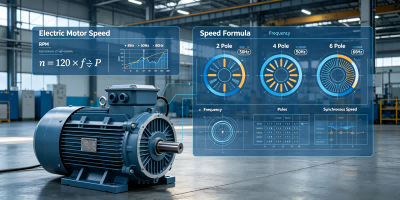
The theoretical speed of an AC motor is determined by supply frequency and the number of poles.
The basic relationship is:
Synchronous Speed (RPM) = 120 × Frequency (Hz) ÷ Number of Poles
For example:
- 50Hz, 2 pole motor: approximately 3000 RPM
- 50Hz, 4 pole motor: approximately 1500 RPM
- 50Hz, 6 pole motor: approximately 1000 RPM
Relationship Between Frequency and Motor Speed
Motor speed changes according to the electrical supply frequency.
The most common industrial frequencies are:
- 50Hz
- 60Hz
A motor designed for 60Hz operation generally runs faster than the same motor operating at 50Hz.
50Hz Motor Speed Explained
Many countries use 50Hz electrical systems, and industrial motors are commonly designed around this frequency.
| Motor Poles | Approximate Speed at 50Hz |
|---|---|
| 2 Pole | 3000 RPM |
| 4 Pole | 1500 RPM |
| 6 Pole | 1000 RPM |
| 8 Pole | 750 RPM |
60Hz Motor Speed Explained
60Hz motors are commonly used in North America and some other regions.
| Motor Poles | Approximate Speed at 60Hz |
|---|---|
| 2 Pole | 3600 RPM |
| 4 Pole | 1800 RPM |
| 6 Pole | 1200 RPM |
| 8 Pole | 900 RPM |
Motor Pole Number Explained
The number of poles in an electric motor determines its operating speed.
More poles result in lower speed but generally provide higher torque capability.
Common industrial motor pole configurations include:
- 2 pole motors
- 4 pole motors
- 6 pole motors
- 8 pole motors
2 Pole Motor Explained
A 2 pole motor is a high-speed motor design.
Typical speeds:
- Approximately 3000 RPM at 50Hz
- Approximately 3600 RPM at 60Hz
Common applications include:
- Fans
- High-speed pumps
- Light industrial equipment
4 Pole Motor Explained
A 4 pole motor is one of the most widely used industrial motor designs.
Typical speeds:
- Approximately 1500 RPM at 50Hz
- Approximately 1800 RPM at 60Hz
4 pole motors provide a good balance between speed, torque and efficiency.
They are commonly used for:
- Pumps
- Compressors
- Fans
- Industrial machinery
6 Pole Motor Explained
6 pole motors operate at lower speeds and provide higher torque characteristics.
Typical speeds:
- Approximately 1000 RPM at 50Hz
- Approximately 1200 RPM at 60Hz
Applications include:
- Heavy-duty pumps
- Large fans
- Industrial equipment requiring lower speed
8 Pole Motor Explained
8 pole motors provide even lower operating speeds and are suitable for applications requiring high torque and stable operation.
They are often used in:
- Large industrial machines
- Heavy processing equipment
- Specialized applications
Motor Speed Comparison Table
| Motor Type | 50Hz Speed | 60Hz Speed |
|---|---|---|
| 2 Pole Motor | 3000 RPM | 3600 RPM |
| 4 Pole Motor | 1500 RPM | 1800 RPM |
| 6 Pole Motor | 1000 RPM | 1200 RPM |
| 8 Pole Motor | 750 RPM | 900 RPM |
Synchronous Speed vs Actual Motor Speed
The calculated motor speed represents synchronous speed.
Actual operating speed is slightly lower because induction motors experience slip.
Slip occurs because the rotor must rotate slightly slower than the magnetic field to produce torque.
Motor Slip Explained
Motor slip is the difference between synchronous speed and actual rotor speed.
For example, a 4 pole 50Hz induction motor may have:
- Synchronous speed: 1500 RPM
- Actual speed: approximately 1450 RPM
The exact speed depends on motor design and load conditions.
High Speed vs Low Speed Motors
Advantages of High Speed Motors
- Smaller motor size
- Lower initial cost
- Suitable for high-speed applications
Advantages of Low Speed Motors
- Higher torque capability
- Smoother operation
- Suitable for heavy loads
How to Select the Correct Motor Speed
The correct motor speed depends on the driven equipment requirements.
Important selection factors include:
- Required output speed
- Torque requirements
- Load characteristics
- Operating environment
- Energy efficiency requirements
Motor Speed Selection for Industrial Applications
Pump Motor Speed Selection
Pump applications often use 2 pole or 4 pole motors depending on flow rate and pressure requirements.
Fan Motor Speed Selection
Fans commonly use higher speed motors because airflow requirements depend on rotational speed.
Compressor Motor Speed Selection
Compressors often require stable speed and suitable torque characteristics.
Conveyor Motor Speed Selection
Conveyor systems usually require controlled speed and reliable torque output.
Motor Speed and Energy Efficiency
Motor speed selection affects energy consumption and system performance.
Choosing the correct speed helps equipment operate efficiently and reduces unnecessary energy usage.
Choosing a Reliable Industrial Motor Supplier
Selecting the correct motor speed requires consideration of application requirements, operating conditions and equipment design.
Ozan Motor supplies industrial electric motors with different speed configurations, including three phase motors, low voltage motors and customized solutions.
Our team helps customers select suitable motors based on speed, power, voltage and application requirements.
Frequently Asked Questions
What is electric motor speed?
Electric motor speed refers to the rotational speed of the motor shaft measured in revolutions per minute (RPM).
How is motor speed calculated?
Motor speed depends on supply frequency and the number of poles in the motor.
What is the speed of a 4 pole motor?
A 4 pole motor runs approximately 1500 RPM at 50Hz and 1800 RPM at 60Hz before considering slip.
What is the difference between 2 pole and 4 pole motors?
A 2 pole motor provides higher speed, while a 4 pole motor provides lower speed with better torque characteristics.
How do I choose the right motor speed?
Motor speed selection depends on application requirements, load conditions and required operating performance.